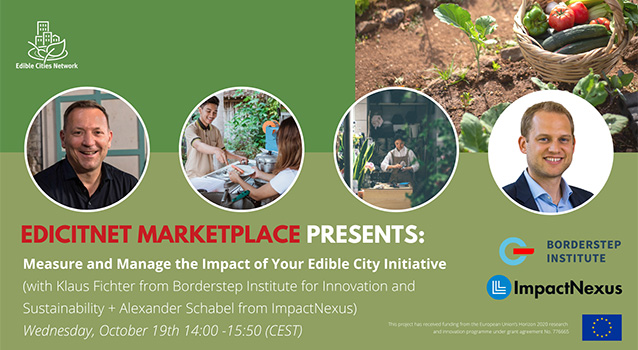
Impact management: Borderstep expertise for urban food organizations
What can impact management achieve for urban food organizations and how can impact be measured in practical terms? This was the subject of an international workshop organized by Borderstep and its spin-off ImpactNexus for the EdiCitNet project.
Edible City organizations strive to maximize impact with their products, services, and activities. But how can impact be measured? And how can it be managed and improved in the long term? The online workshop offered international participants the opportunity to implement the first steps in setting up impact management for their organization.
Innovative solutions for the Edible City
The event was opened by Dr. Ina Säumel. She leads the EdiCitNet project at the IRITHESys research institute at Humboldt University in Berlin. Her presentation introduced the international network established by the project for cities that promote and foster innovative Edible City Solutions such as neighborhood gardens, green facade projects or beekeeping programs.
Prof. Dr. Klaus Fichter, Director of the Borderstep Institute, provided insight into impact management concepts, such as the logic model and the cycle of impact management, which form an important basis for the practical implementation of impact measurement.
Impact management tried out in practice
Based on this, Alexander Schabel, Co-Founder of ImpactNexus, introduced practical aspects for impact management. ImpactNexus is a spin-off of the Borderstep Institute that develops software products for companies to measure and improve their sustainability impact. With expert guidance and support from Alexander Schabel, the interactive session gave participants the opportunity to use ImpactNexus’ Impact Goal tool to define their organization’s impact goals, develop an impact model, and define corresponding impact indicators.
In this way, by the end of the workshop, the participants had gone through the first steps necessary to build an impact management system. Now they can use this as a basis for further implementation with their team.
The Edible Cities Network (EdiCitNet) is an EU-funded project to develop and implement innovations in the edible city sector – for green, edible and above all livable cities. The online workshop was offered as part of the EdiCitNet Marketplace, a global platform for networking and strengthening urban food initiatives. The Marketplace is a digital platform for initiatives and organizations that create innovative solutions for urban food production worldwide.
 © BMWK - Anja Blumentritt
 © BMWK - Anja Blumentritt
Federal Ministry for Economic Affairs and Climate Action honors Borderstep project
The European collaborative project “ScaleUp4Sustainability” convinced the jury of this year’s European Enterprise Promotion Awards (EEPA) and is now among the three finalists of the competition in the category “Supporting the Sustainable Transition”. The winner will be selected at the end of November in Prague (Czech Republic).
The collaborative project had already won the German preliminary competition. Project leader Prof. Dr. Klaus Fichter, Professor of Innovation Management and Sustainability at the Carl von Ossietzky University of Oldenburg and Director of the Borderstep Institute for Innovation and Sustainability, now accepted the award at the German Federal Ministry of Economics and Climate Action (BMWK).
Europe is facing major challenges, for example in climate change and energy supply. We need innovative concepts that accelerate the ecological transformation of the economy and society. Our collaborative project ScaleUp4Sustainability rethinks entrepreneurship. Students and companies from various European countries are working together to develop sustainable products and business models: This is how economic solutions are combined with environmental and climate protection. We are delighted that the BMWK has publicly recognized our victory in the German preliminary round of EEPA 22.
For the 16th time, the jury of the European Commission will award outstanding projects and initiatives for the promotion of entrepreneurship with the European Enterprise Promotion Awards (EEPA). For the third time in a row, both winning projects of the German preliminary competition have made it to the shortlist of the European jury this year and are in the final of the European Enterprise Promotion Awards (EEPA): The “Action Program Inner City & Future Fund Inner City” of the Bremen Economic Development Agency and the European joint project “ScaleUp4Sustainability”, led by the Carl von Ossietzky University Oldenburg, in which Borderstep is involved, now have a great chance of receiving an award during the SME Assembly in Prague at the end of November.
Joint project focuses on cooperative green venturing
The European collaborative project ScaleUp4Sustainability developed innovative concepts for cooperation between students and companies from Germany, Sweden and the Netherlands using practical teaching and learning formats (cooperative green venturing). The three-and-a-half-year project was funded by the EU as part of the “Erasmus-Plus” support programme. The focus was on the convergence of sustainability and economics in the development of new business models. The ten partners in the joint project include the Carl von Ossietzky University of Oldenburg as joint coordinator and the Borderstep Institute for Innovation and Sustainability. The “Challenge4Impact” project, which started in February 2022, builds on the approaches developed for cooperative green venturing.
EEPA recognizes promotion of entrepreneurship
Since 2006, the European Commission has annually awarded publicly funded or volunteer initiatives and non-profit companies dedicated to promoting entrepreneurship and enterprise with the European Enterprise Promotion Awards. The two-stage competition with six competition categories is held in the EU member states as well as in Albania, Armenia, Bosnia Herzegovina, Great Britain, Iceland, Kosovo, Moldova, Montenegro, Northern Macedonia, Serbia, Turkey and Ukraine. The participating countries identified a maximum of two projects or initiatives from two different categories in the course of national preliminary decisions – conducted in Germany by the RKW Competence Center in Eschborn – that stand out for their particularly innovative and inspiring support services. At the end of September, the international jury nominated 20 finalists for the 2022 round of the competition.
The European Enterprise Promotion Awards will be presented on November 29, 2022, during the EU Commission’s SME Assembly in Prague, Czech Republic. The SME Assembly is one of the most important events for small and medium-sized enterprises in Europe.
The shortlist with all finalists of the 2022 competition round can be found here.
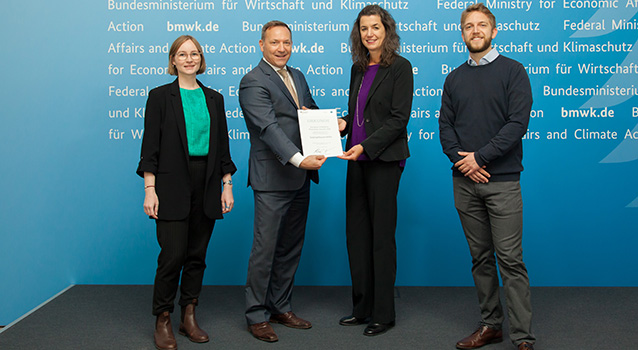
Photo 1: Team ScaleUp4Sustainability receives the certificate at the BMWK as winner of the German preliminary round of EEPA 2022. In the picture: Alexandra Widrat, Researcher, Borderstep Institute; Prof. Dr. Klaus Fichter, University of Oldenburg and Borderstep Institute; Dr. Sabine Hepperle, Head of the Department of SME Policy at the BMWK; Johann Tölle, Student Representative, University of Oldenburg.
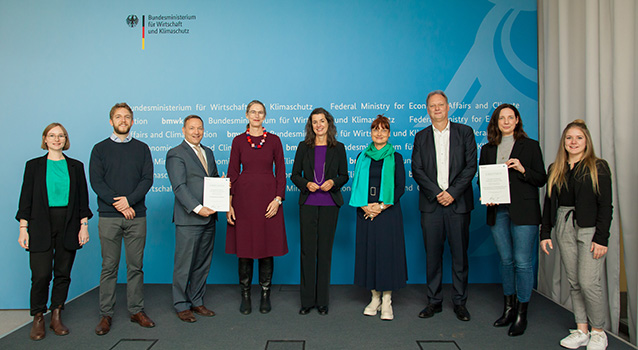
Photo 2: The winners in the German preliminary round of the EEPA 2022, the European joint funding project “ScaleUp4Sustainability” led by the University of Oldenburg and project “Bremen becomes new” of the Bremen Economic Development Corporation. Certificate presentation at the Federal Ministry for Economic Affairs and Climate Action.
Special Issue “Journal of Cleaner Production” published
The Journal of Cleaner Production has now published a special issue on assessing and forecasting the impact of new ventures on sustainability. Borderstep Director Prof. Dr. Klaus Fichter is one of the guest editors.
Start-ups implement environmental innovations
The Special Issue highlights entrepreneurs and start-ups as key players in the implementation of environmental innovations and new approaches to cleaner production. For entrepreneurship to promote sustainable development, it is crucial to understand how established firms and emerging young companies have a positive impact on sustainability.
Assessment of sustainability impacts of start-ups hardly researched so far
The sustainability impact of established companies and their products and services has been a key topic in business-related sustainability research for many years. This is true, for example, in the fields of social and sustainability accounting and reporting as well as entrepreneurship research. However, the assessment of sustainability impacts of start-ups, for example by means of life cycle assessments or social impact analyses, is a neglected area of research. The special issue of the Journal of Cleaner Production aims to change that.
The Journal of Cleaner Production is an international, transdisciplinary journal focusing on research and practice in the fields of cleaner production, the environment and sustainability. Through the articles we publish, the publication aims to help society become more sustainable.
Guest editors of the special issue are:
- Klaus Fichter, Borderstep Institute and Carl von Ossietzky University Oldenburg, Germany
- Florian Lüdeke-Freund, ESCP Europe Business School, Germany
- Stefan Schaltegger, Leuphana University, Germany
- Simon Schillebeeckx, Management-University Singapore, Singapore
The articles of the Special Issue can be accessed via this link.
Borderstep project in the final of the European Enterprise Promotion Awards
Success for Borderstep project: For the third time in a row, both winning projects of the German preliminary round have made it to the shortlist of the European jury and are in the final of the European Enterprise Promotion Awards (EEPA): The “Action Programme Inner City & Future Fund Inner City” of the Bremen Economic Development Agency and the European joint project ScaleUp4Sustainability, in which Borderstep participated, now have a great chance of winning an award during the SME Assembly in Prague at the end of November.
Promoting entrepreneurship
For the 16th time, the jury of the European Commission will award outstanding projects and initiatives to promote entrepreneurship with the European Enterprise Promotion Awards (EEPA). This year, both winning projects from the German preliminary round made it to the European final of the competition: the measures developed and implemented by the Bremen Economic Development Agency as part of the “Action Programme City Centre & Future Fund City Centre” to revitalise the city centre in connection with the Corona pandemic and the European joint project ScaleUp4Sustainability, led by the Carl von Ossietzky University Oldenburg, in which students worked together with companies to develop new concepts that think about business models both economically and ecologically.
Since 2006, the European Commission has awarded the European Enterprise Promotion Awards annually to publicly funded or volunteer-run initiatives and non-profit enterprises dedicated to promoting entrepreneurship and enterprise. The two-stage competition with six competition categories is held in the EU Member States as well as in Albania, Armenia, Bosnia and Herzegovina, Great Britain, Iceland, Kosovo, Moldova, Montenegro, Northern Macedonia, Serbia, Turkey and Ukraine. The participating countries identify a maximum of two projects or initiatives from two different categories in the course of national preliminary decisions – in Germany carried out by the RKW Competence Centre in Eschborn – that stand out for their particularly innovative and inspiring support services. At the end of September, the international jury nominated 20 finalists for the 2022 competition round.
Final: Teams from Germany focus on the future
The European-funded Borderstep project ScaleUp4Sustainability developed innovative concepts for cooperation between students and companies from Germany, Sweden and the Netherlands with the help of practical teaching and learning formats (cooperative green venturing). The three-and-a-half-year project was funded by the EU as part of the “Erasmus-Plus” funding programme. The focus was on thinking sustainability and economics together in the development of new business models. The institutional national partners were the Carl von Ossietzky University Oldenburg and the Borderstep Institute for Innovation and Sustainability. The “Challenge4Impact” project, which started in February 2022, builds on the approaches developed for cooperative green venturing.
Under the motto Bremen is becoming new, a variety of measures provide more quality of stay in the city centre. This strengthens the city in the long term. The initiative is a joint project of the Senate Chancellery, the Senator for Economics, Labour and Europe, the Senator for Climate, Environment, Mobility and Urban Development and the Senator for Culture, under the leadership of Mayor Dr. Andreas Bovenschulte and financed by the Bremen Fund. WFB Wirtschaftsförderung Bremen GmbH develops and implements various concepts within the framework of this Bremen Action Programme and the City Centre Future Fund. For example, concept store and pop-up store competitions have been held to revitalise empty retail spaces and thus offer innovative concepts a location in a prime location and increase diversity in the city centre.
The European Enterprise Promotion Awards will be presented on 29 November 2022 during the EU Commission’s SME Assembly in Prague, Czech Republic. The SME Assembly is one of the most important events for small and medium-sized enterprises in Europe. The nomination for the final is already a great success for the Borderstep project.
Further information on the competition can be found here and on the EU Commission’s news portal.
Shortlist with all finalists of the 2022 competition round.
Borderstep at Academy of Management (AOM) 2022
Borderstep Director Prof. Dr. Klaus Fichter has been invited to speak at the Academy of Management AOM 2022 conference on August 5, 2022. He will give this talk in the context of a Paper Development Workshop on “Start-up Support Promoting Circular Economy within Entrepreneurial Ecosystems”.
The title of the talk is “Growing for sustainability: a multi-level framework of startup growth in sustainable transition pathways”.
The conference will take place in parallel in Seattle, USA as well as online. Klaus Fichter will attend the event online for climate protection reasons.
The Academy of Management (AOM) is the leading professional association for management and organization scholars. Members include professors and Ph.D. students in business schools and at universities, academics in related social sciences and other fields, and practitioners who value the creation and application of knowledge. AOM was founded in 1936 and today includes nearly 18,000 members in more than 120 countries.
More information about the conference and program can be found here.
What is Germany’s Cleantech Strategy?
In his paper for the Israel Public Policy Institute, Severin Beucker, Senior researcher at Borderstep, presents the current status of the discussion on the topic of cleantech in Germany. He shows how the country has developed in terms of environmental protection and climate technology gives an outlook into the future.
From the 1970s onward, Germany led the way in cleantech and environmental protection. Early German environmental policy focused primarily on pollution control in the areas of water, air, soil, and waste disposal. However, in the 1980s, renewable energy and nuclear phaseout became the focus.
The paper is available free of charge.
The Israel Public Policy Institute (IPPI) is an independent non-profit think and do tank based in Tel Aviv with representations in Berlin and New York. It strives to foster fresh thinking on how to tackle some of the most pressing policy challenges of the 21st century from within an international and interdisciplinary perspective.
Digital building technologies: Borderstep at ICT4S 2022
Borderstep presented current research results at ICT4S 2022 ICT for Sustainability. Every year, the international conference bring together leading researchers in ICT for Sustainability with government and industry representatives, including decision-makers with an interest in using ICT for sustainability, researchers focusing on ICT effects on sustainability and developers of sustainable ICT systems or applications.
This year, the conference was held as a hybrid event at the University of Plovdiv in Bulgaria from June 13 to 17, 2022.
Borderstep presents study for digital association Bitkom at ICT4S
Borderstep was represented at ICT4S 2022 by two experts. Borderstep Managing Director Dr. Severin Beucker and Borderstep Researcher Simon Hinterholzer from the Digitisation and Green IT research area presented the results of a study for the digital association Bitkom.
“Building automation can save large amounts of fossil energy and emissions by 2030. That’s what our study for Bitkom shows.” Dr. Severin Beucker, shareholder and senior researcher at the Borderstep Institute, emphasizes.
Building automation could make almost 10% of gas imports from Russia dispensable
In view of the current political situation, the topic of energy saving takes on a whole new significance. Energy efficiency is the key here, says Severin Beucker. “According to a recent Borderstep calculation, the use of building automation can make almost 10% of Russian gas imports dispensable.”
The study on Klimaschutz und Energieeffizienz durch digitale Gebäudetechnologien includes the results for the German building sector. It assessed whether and how the study’s building model and assessment of climate protection potential can be used in other European countries. The paper also assesses how CO2 savings in the building sector can be incorporated into climate protection strategies.
The ICT4S conference also served as an opportunity for the Borderstep scientists to exchange ideas on an international level on the subject of ICT and sustainability. Digitalization can make an important contribution to solving the energy crisis, Simon Hinterholzer, researcher at Borderstep, is certain. “We need to quickly reduce energy demand with available efficiency measures such as building automation and, in parallel, further expand the supply of renewable energies.”
Simon Hinterholzer’s commentary on the situation looks suitably optimistic: “Our studies show: We have the technology to drive our energy independence. Now it’s a matter of implementing these solutions quickly.”
BPW: Borderstep promotes Special Award Sustainability
As a partner of the Business Plan Competition Berlin-Brandenburg (BPW), the Borderstep Institute sponsors the Special Award Sustainability, which will be awarded during the 3rd award ceremony of the BPW 2022 on July 4.
The Special Award Sustainability is endowed with 5,000 euros and is jointly sponsored by BPW and Borderstep. Borderstep Director Prof. Dr. Klaus Fichter is a member of the jury and will present the prize to the winning team on July 4, 2022.
BPW is the first business plan competition in Germany to have introduced the topic of sustainability into every chapter of the business plan. This means that all participants must take a binding approach to sustainability in their business concept. Corresponding online-seminars teach the basics. For the evaluation of the economic component, the entire business plan or canvas model is considered. The BPW manual thus supports all founding teams in taking into account sustainability issues relevant to success in the development of their business concept.
Borderstep has been supporting the BPW for many years in integrating the topic of sustainability into the entire BPW process and offerings. Among other things, the Borderstep Institute has systematically incorporated issues and aspects of economic, ecological and social sustainability into the sample templates for BPW business plans and BPW canvases.
In addition, Borderstep offers workshops on business model development with the Sustainable Business Canvas as part of the BPW.
Special Award Sustainability 2021: Fungtion

By loading the video, you agree to YouTube’s privacy policy.
Learn more
Special Award Sustainability 2020: Heatle
By loading the video, you agree to YouTube’s privacy policy.
Learn more
EEPA: Borderstep project wins German preliminary round
The European joint project “ScaleUp4Sustainability” represents Germany in the final of the European Enterprise Promotion Awards (EEPA).
The project, which is funded by the EU’s Erasmus+ program, won the German preliminary round. In this project, Borderstep, together with partners from Germany, Sweden and the Netherlands, developed innovative concepts for cooperation between students and companies with the help of practical teaching and learning formats (cooperative green venturing). The concepts developed as part of the project are intended to help anchor sustainability as a natural component in any new business model. Since 2006, the European Commission has presented the European Enterprise Promotion Awards annually to public authorities, business and educational institutions, and public-private partnerships that are committed to supporting entrepreneurship.
Combining economic and ecological thinking in a targeted manner right from the start of new companies: That was the goal of the European collaborative project ScaleUp4Sustainability (S4S). Together with the University of Oldenburg (Germany), Linköping University (Sweden) and Vennebroek Academic Services (Netherlands), the Borderstep Institute brought together students and companies from the respective regions. Participating companies in Germany were the chemical company BÜFA, Europe’s leading photo service provider CEWE and the utility company EWE; in Sweden, the waste-to-energy company Againity and the utility company Tekniska Verken; and in the Netherlands, the company ECOR, manufacturer of circular building material products, and the company Fujifilm Europe. Together with the students, they developed concepts on how sustainability can be anchored as a natural component in any new business model. The Sustainable Venturing Challenges platform developed by Borderstep as part of S4S supports teachers, students and companies in establishing contacts and collaboration for cooperative green venturing projects.
Prof. Dr. Klaus Fichter, Head of Project ScaleUp4Sustainability (Professor for Innovation Management and Sustainability, Carl von Ossietzky University Oldenburg and Director Borderstep Institute for Innovation and Sustainability, Berlin): ScaleUp4Sustainability rethinks entrepreneurship with a view to the major challenges of the future. The concept we have developed of students and companies working together to develop innovative and sustainable products and business models gives rise to concrete ideas and implementation projects that combine economic solutions with environmental and climate protection. We call this novel concept cooperative green venturing.
Project with exemplary character
The project emerged victorious from the national preliminary round of the European Commission’s European Business Support Awards. It will represent Germany in the final, according to the RKW Competence Center, organizer of the preliminary competition on behalf of the German Federal Ministry of Economics and Climate Protection. In the fall, S4S will compete in the international final.
Prof. Dr. Florian Täube, Head of the Start-up Department at the RKW Competence Center: “ScaleUp4Sustainability meets various significant challenges of our time and shows great exemplary character. Both students and companies benefit from the collaboration: the former from the opportunity to develop sustainable solutions to real problems, the latter from the new ideas and impulses for their future-proof corporate development. At the same time, climate change is taken into account in the course of the newly developed business models and a contribution is made to social progress.”
Since 2006, the European Commission has awarded the European Enterprise Promotion Awards EEPA annually to public authorities, business and educational institutions, and public-private partnerships that are committed to supporting entrepreneurship. The competition is held in the EU member states as well as in Albania, Armenia, Bosnia and Herzegovina, Great Britain, Iceland, Kosovo, Moldova, Montenegro, Northern Macedonia, Serbia, Turkey and Ukraine. The German Federal Ministry of Economics and Climate Protection (BMWK) is sponsoring the German preliminary round of the competition and has commissioned the RKW Competence Center with national coordination.
The winners of the European Enterprise Promotion Awards EEPA 2022 will be announced on November 29 during the SME Assembly of the European Commission in Prague.
More information about the European Enterprise Promotion Awards EEPA and the German preliminary round can be found here.
What is ScaleUp4Sustainability?
The European collaborative project ScaleUp4Sustainability developed innovative concepts of cooperation between students and companies from Germany, Sweden and the Netherlands using practical teaching and learning formats (cooperative green venturing). The three-and-a-half-year project was funded by the EU as part of the Erasmus+ funding program. The focus was on the convergence of sustainability and economics in the development of new business models.
- University of Oldenburg https://uol.de/en/innovation
- Linköping University https://liu.se/en/organisation/liu/iei
- Vennebroek Academic Services http://www.createnewbusiness.com/Welcome.html
- EWE https://www.ewe.com/
- BÜFA https://www.buefa.de/
- CEWE https://www.cewe.de/
- Tekniska Verken https://www.tekniskaverken.se/about-tekniska-verken/about-us/
- Againity https://againity.com/
- ECOR https://ecorglobal.com/
- Fujifilm Europe https://global.fujifilm.com/en/all-regions/eu
- Borderstep Institute https://www.borderstep.org/
More about the project can be found on the project website.
Borderstep at the IHK Potsdam foundation meeting
Borderstep at the IHK Potsdam foundation meeting: Sustainable start-ups are on the rise. Especially companies from the food and nutrition industry are successful. However, they face challenges – including matchmaking with SMEs, access to capital and securing skilled workers.
What does the path of green start-ups look like? What are the success factors? Where are the difficulties? These questions will be discussed at the Gründungstreff Potsdam.
Borderstep Director Prof. Dr. Klaus Fichter will present current research results on green start-ups as keynote speaker. Registration is now open.
PROGRAMME GRÜNDUNGSTREFF IHK POTSDAM, 28 June 2022, 3 – 7 pm
15 Uhr | WELCOME | Welcome talk with:
- Prof. Dr. Dr. Mario Tobias (CEO IHK Potsdam)
- Bernd Rubelt (Councillor of the State Capital Potsdam for Urban Development, Construction, Economy and Environment)
15:15 Uhr | KEYNOTE
Impulse lecture on the topic “Sustainable founding: results and learnings from the Green Startup Monitor 2022”.
- Prof. Dr. Klaus Fichter, Borderstep Institute for Innovation and Sustainability gGmbH
15:45 Uhr | INSIGHTS
4 x 5-minute roundtable with regional companies:
- Philipp Hommelsheim New Path Solutions GmbH – Carmino
- Dr. Ina Henkel EntoNative GmbH -Tenetrio
- Holger Behrens Bio4Friends – Naturfleischerei
- Dr. Oswald Blumenstein InterEnviroCon GmbH
16:15 Uhr | FISHBOWL-TALK
“Sustainable founding and growth – how does it work?” Talk with:
- Thorsten Jahnke social impact gGmbH
- Prof. Dr. Dr. Mario Tobias IHK Potsdam
- Tobias Ahrens Berliner Volksbank eG
- Björn Kaminski Startup Verband
- Philipp Hommelsheim New Path Solutions GmbH – Carmino
- Dr. Ina Henkel EntoNative GmbH -Tenetrio
- Holger Behrens Bio4Friends
18:30 Uhr | GET-TOGETHER
Closing and networking opportunities with a small snack and drinks
Moderation:
Marie-Lucie Linde

 Green Economy